

Noncredit & Community Education
Noncredit programs shouldn't run on spreadsheets and hope.
Workforce training. ESL. Professional development. Community ed. Every noncredit program deserves the same operational structure as your credit programs — without being forced into a credit workflow.
Campus Credit gives colleges one system to launch, enroll, collect payment, track participation, and report outcomes — built for noncredit from the ground up, not adapted from a credit workflow that was never designed for it.

Program Types
What does a noncredit program look like in Campus Credit?
Click any program type to see a real example of how it runs inside Campus Credit — from setup and enrollment through completion and reporting.
Example Program
Forklift Operator Certification — 40 Hours
A workforce development center partners with local warehousing employers to run a 40-hour forklift certification program. Classes run two evenings a week for four weeks. Enrollment is open with a $299 fee. Participants who complete 36 of 40 hours and pass a written assessment receive a certificate of completion and are added to a shared employer referral list.
How Campus Credit manages it
Coordinator creates the program with an hourly requirement, assessment pass threshold, and employer partner details — no SIS needed
Participants register and pay $299 online — no invoice sent separately, no unpaid seats held open
Instructor marks attendance each session — system flags anyone below the 36-hour threshold before the program ends
Participants who meet the threshold get a digital certificate — no manual generation, no emailing PDFs
Completion data structured and ready for Strong Workforce Program, workforce board, and CDCP reporting
Example Program
Noncredit ESL Level 3 — Intermediate Conversation
A community college runs six levels of noncredit ESL with open enrollment each term. Level 3 runs Monday, Wednesday, and Friday mornings for 16 weeks. Enrollment is free per state apportionment funding. Students complete a placement assessment before their first class. Completion is tracked for CDCP reporting and students are guided toward credit ESL pathways at the end of the term.
How Campus Credit manages it
Each level configured as a separate program with its own schedule, capacity, and placement prerequisite — managed from one dashboard
Students complete or upload placement results during registration — coordinator sees clearance before class starts
Attendance records structured for CDCP and state apportionment reporting — no manual compilation at term end
Completers are flagged for credit ESL pathway outreach — completion data feeds directly into Guided Pathways reporting
Student record tracks which ESL levels they've completed over time — visible for advising and equity reporting
Example Program
Project Management Fundamentals — 24 Hours / 3 CEUs
A continuing education division offers a 24-hour Project Management Fundamentals course for working professionals. The course runs over six Saturday sessions and awards 3 Continuing Education Units (CEUs) upon completion. Participants pay $450 and receive a signed certificate of completion they can submit to their employer for reimbursement or professional license renewal.
How Campus Credit manages it
Set the CEU value, contact hours, and completion threshold — certificates issued automatically with the correct CEU count
Participants receive a payment confirmation and certificate they can submit directly to their employer — no coordinator involvement
Certificate issued with instructor and program director signatures, program name, CEUs, and completion date — downloadable immediately
Professionals who take multiple courses build a continuing education transcript — visible for advising and employer reporting
Run the same course multiple times per term with different schedules, instructors, and locations — all from one program shell
Example Program
Introduction to Watercolor Painting — 8 Sessions
The community education office runs 40+ personal enrichment and community programs each term — from cooking classes to financial literacy workshops. Introduction to Watercolor runs eight Tuesday evenings with a $125 enrollment fee. The instructor manages their own roster, the college collects the fee, and a completion record is generated for students who attend at least six of eight sessions.
How Campus Credit manages it
Run 40+ community ed programs from one dashboard — each with its own schedule, instructor, capacity, and pricing
Community members browse the catalog, pick a class, and pay — no application process, no waiting for approval
Instructors see only their class — roster, attendance sheet, and completion status — without full admin access to the system
When a class fills, additional registrants go to a waitlist — and are notified automatically if a seat opens
Total enrollment, fees collected, and completion rates across every community ed offering — in one real-time dashboard
Example Program
Leadership Development for County Supervisors — Custom Cohort
The college's contract education division partners with the County to deliver a 30-hour leadership development program for 25 county supervisors. The county pays a flat contract fee. Supervisors are enrolled by HR, not through a public portal. Attendance is tracked and a completion report is delivered to the county at program end for employee records and reimbursement documentation.
How Campus Credit manages it
Program not visible in the public catalog — HR enrolls employees directly with a private access link or bulk upload
Contract fee invoiced to the employer rather than collected per-participant at enrollment — payment tracked at the contract level
Session-by-session attendance documented and exportable in a format ready for the employer's HR system or reimbursement process
At program close, a structured completion report shows who completed, who didn't, and total hours — ready to send to the county HR office
Each county supervisor receives a digital certificate of completion with hours, program name, and institution signature
Example Program
Phlebotomy Technician — 120 Hours / Noncredit Certificate
The health sciences division runs a 120-hour noncredit phlebotomy program that leads to a California Phlebotomy Technician I certification. The program runs on a cohort model — one cohort per term, 20 students max. Participants complete 80 hours of didactic instruction and 40 hours of clinical externship before sitting for the state exam. Fee is $1,200, with a payment plan option.
How Campus Credit manages it
20-student cap enforced automatically — additional applicants go to a waitlist and are notified when seats open for the next cohort
Students can split the $1,200 fee into installments — payment schedule tracked and reminders sent automatically
Two phases tracked independently — didactic attendance and clinical externship hours logged with separate completion thresholds
Clinical sites and supervisors managed in the system — placement confirmed and hours verified before certificate is issued
Certificate issued with program completion data formatted for California phlebotomy board submission
Example Program
Cybersecurity Fundamentals Bootcamp — 10 Weeks
The college's workforce institute runs an intensive 10-week cybersecurity bootcamp targeting career changers and recent graduates. The program runs Tuesday and Thursday evenings plus one Saturday per month. Fee is $1,800 with an early registration discount of $200. Students who complete the program and pass a capstone assessment receive a digital badge and a letter of completion for employer presentation.
How Campus Credit manages it
Automatic discount applied for registrations before the early deadline — no manual coupon codes or coordinator intervention
In-person and online attendance tracked in the same session record — completion threshold calculated across both modalities
Certificate and badge only issued after both attendance and capstone requirements are confirmed — no partial completions slipping through
Structured letter of completion generated with program details, dates, and hours — formatted for employer HR systems and LinkedIn skills verification
Program updates, schedule changes, and reminders sent to the entire cohort from the system — no coordinator managing a group email thread
Example Program
Beginning Guitar for Adults — 6-Week Session
The community education office runs dozens of personal enrichment classes each term — yoga, cooking, photography, language conversational practice, and music. Beginning Guitar runs six Wednesday evenings for $85. Students supply their own guitar. No prerequisites, open to anyone in the community. Class is capped at 15 to maintain an intimate learning environment. No certificate is issued — just a great class.
How Campus Credit manages it
New enrichment classes configured in minutes — the office runs 50+ sections per term without IT involvement or SIS tickets
Community members browse all enrichment offerings, filter by day or topic, and register in two clicks — no login required to browse
Once 15 students register, additional interest goes to a waitlist — next session gets pre-filled with interested students before it even opens
Programs configured without certificate issuance — participation record maintained for internal reporting without generating credentials
Total fees collected across all enrichment programs visible in one dashboard — by term, category, or instructor
Overview
One system to launch, run, and scale your noncredit division
Campus Credit Noncredit is a centralized system designed to help colleges launch, manage, and scale noncredit programs — from student application and enrollment to program delivery and completion tracking.
It replaces disconnected tools — a registration form here, a payment link there, a spreadsheet to track who showed up — with a single, streamlined workflow that operates at the speed noncredit demands. Programs can launch faster, revenue lands where it should, and your team spends time growing programs instead of chasing paperwork.
Every step is structured, trackable, and built for speed — whether you're running one workforce cohort or fifty community ed sections a term.
Students enroll and pay in a single guided workflow — no separate invoicing, no chasing unpaid registrations, no dropped seats
Create a new noncredit offering with flexible start dates, pricing tiers, capacity limits, and eligibility requirements — without calling IT
Live dashboards show enrollment numbers, revenue collected, attendance, and completion rates — across all programs at once
Issue certificates of completion automatically, maintain a structured participation record for every student, and export for state CDCP or workforce reporting
The Problem Today
Most noncredit programs are leaving revenue on the table.
Not because demand is low — but because enrollment, payment, and tracking are split across tools that were never built for noncredit. Students fall off between the registration form and the payment step. Attendance is tracked in spreadsheets. Completion records don't exist in a format anyone can report on.
As programs scale — especially for workforce training, ESL, or international cohorts — institutions struggle to manage enrollment, track participation, and report outcomes without adding staff or building custom solutions.
A purpose-built noncredit workflow lets institutions move faster, operate independently from the credit SIS, and grow program offerings with confidence — without stitching together tools that were never designed to work together.
When registration and payment are separate steps, students drop off — seats go unfilled and revenue that should be captured isn't
Noncredit students are adults with jobs and schedules — the moment the enrollment process feels like applying to college, they leave
State CDCP, workforce board, and grant reports require structured completion data — which doesn't exist when attendance lives in spreadsheets
One guided enrollment experience, payment collected at registration, and a structured completion record ready for every report you need to run
Enrollment and payment in one guided flow — no drop-off between registration and checkout
Time to launch a new noncredit program — not weeks of SIS configuration and IT tickets
Attendance, completion, revenue, and reporting — all structured, all real-time, all in one system
Key Features
Everything your Study Away office needs to scale
Campus Credit gives you a complete noncredit infrastructure — from program setup and enrollment through payment, participation tracking, completion, and reporting.
Create noncredit programs with flexible start dates, pricing models, capacity limits, eligibility requirements, and document collection — without IT involvement or SIS configuration timelines.
Students enroll through a simple, clean experience — no credit SIS friction, no confusing portal, no support calls. Collect all required information, documents, and waivers upfront in one flow.
Accept payment at enrollment — credit card, check, or invoice — so you're never chasing unpaid registrations after a program starts. Partial payments and payment plans configurable per program.
Collect and manage required documents — ID verification, program agreements, health disclosures, and waivers — all required before a student's enrollment is confirmed.
Track attendance, engagement, and program milestones throughout delivery. Real-time visibility into who is participating, who is falling behind, and who has met completion requirements.
Issue certificates of completion automatically, maintain structured participation records for every student, and export enrollment, revenue, and completion data for state CDCP, workforce board, and grant reporting.
Noncredit-to-Credit Pathways
Noncredit as an on-ramp — not a dead end
The strongest noncredit programs are the ones that connect to something bigger. Campus Credit supports structured noncredit-to-credit pathways — so a student who completes a workforce ESL course can see a clear path into a credit certificate, and the institution can track and report on that progression.
This is what equity-minded noncredit programs look like in practice — measurable, reportable, and connected to the student's broader academic journey.
Noncredit completion data structured in Campus Credit feeds directly into the pathway reporting your institution needs for Guided Pathways, Strong Workforce, and CDCP compliance.
Noncredit ESL completers with a clear course pathway to credit ESL and transfer-level English
Short-term workforce training that stacks toward a noncredit or credit CTE certificate of completion
Continuing professional education units that map toward credit coursework or degree requirements
Community education participants converted to matriculated students through a structured on-ramp
How It Works
From program setup to completion — in six stages
Every noncredit program in Campus Credit follows the same structured workflow — from configuration and enrollment through delivery, completion, and reporting.
Set up your noncredit offering with flexible schedules, pricing, capacity limits, eligibility requirements, and required documents — built for short-term and workforce programs, not semester-based credit timelines.
Students apply through a simple guided experience — collect required information, documents, and payment in one streamlined workflow. No credit SIS friction, no support tickets, no dropped conversions.
Track enrollment, attendance, and engagement in real time. Keep programs organized without spreadsheets or manual follow-up — every student's status visible in one dashboard.
Run your program with full visibility — manage communications, updates, and participant progress from a single system. Instructors see their roster and completion status without coordinator involvement.
Confirm participation, record completion status, and issue certificates or outcome records where applicable — automatically, without manual certificate generation or email follow-up.
Real-time dashboards on enrollment, revenue, attendance, and completion — by program, term, or cohort. Structured exports for state CDCP, workforce board, Strong Workforce, and grant reporting.
Who It's Built For
Designed for teams that need to move fast
Noncredit programs don't fit into traditional academic systems. Campus Credit gives your team the flexibility to launch, manage, and scale programs without delays, IT tickets, or workarounds.
Colleges & Workforce Programs
Create programs, open enrollment, collect payment, and track completion from one centralized system — eliminating spreadsheets, manual processes, and disconnected tools. Scale offerings without adding administrative overhead.
Program Directors & Coordinators
Easily manage enrollment, track participation, and oversee program delivery in real time. No custom workflows to build, no information to chase across systems, no manual reports to compile at the end of every term.
Students & Community Participants
Noncredit students are adults with jobs and schedules — they need a clean, fast enrollment process, not a college admissions portal. Campus Credit provides that experience from signup through completion and certificate.
SIS Integration
Works with your existing systems — or independently
CampusCredit Noncredit can operate completely independently from your credit SIS — or feed noncredit completions into Banner or Colleague for institutions that want them in the same student record. You choose the integration level that works for your team.
Campus Credit Noncredit runs its own enrollment, payment, and completion workflow — no SIS configuration needed to launch a new program
Download structured enrollment, payment, and completion files formatted for your SIS upload — no manual reformatting
Build toward bidirectional SIS integration over time — Campus Credit works at whatever level your IT team is ready for
Structured completion data ready for California CDCP, Strong Workforce, workforce board, and grant reporting — no manual compilation
Ready to scale your noncredit programs?
Launch faster. Collect revenue. Grow with confidence.
Most colleges are fully live within 30 days. Schedule a 30-minute demo and we'll walk through your noncredit workflows — enrollment, payment, tracking, and reporting.
No commitment required · Live in 30 days · Standalone or SIS-connected
In-Platform Screens
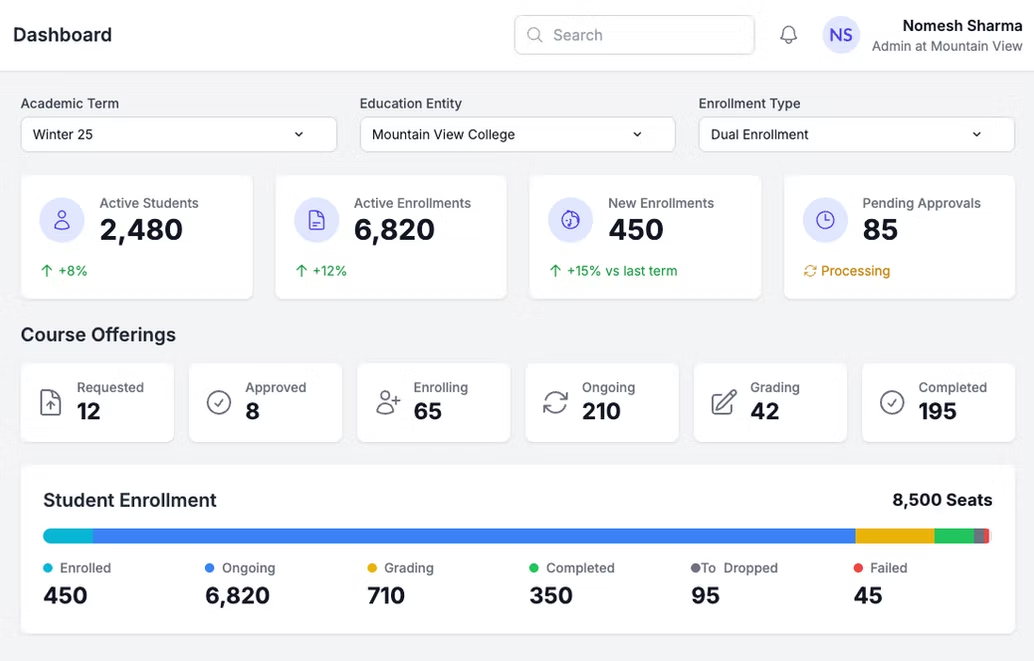
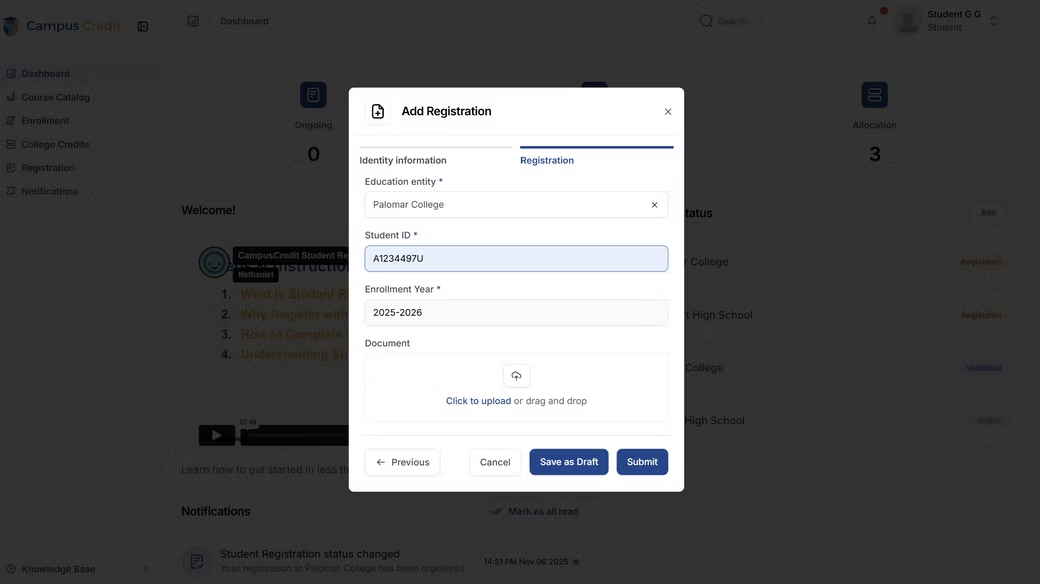
A single platform to launch, manage, and scale noncredit programs from enrollment to completion.
